

Kali: The Great Equalizer: Why Filipino Martial Arts is the Ideal Self-Defense System for Women

When people talk about women's self-defense, there is an uncomfortable reality that sometimes gets overlooked:
Strength matters.
If a woman is confronted by a significantly larger and stronger attacker, simply telling her to punch harder, wrestle harder, or become physically stronger doesn't completely solve the problem.
She may be facing someone who outweighs her by 50, 75, or even 100 pounds.
So the question shouldn't simply be:
How can a woman become stronger?
A better question may be:
How can she change the equation altogether?
That's one of the reasons Filipino martial arts such as Kali and Escrima can be such powerful systems of self-defense for women.
Kali doesn't assume that two people entering a confrontation will be the same size, possess the same strength, or even be equally armed.
Instead, Kali teaches you how to use timing, distance, angles, leverage, movement, awareness—and tools—to compensate for physical disadvantages.
In that sense, Kali can become the great equalizer.
Strength Is Important—but It Isn't Everything
There is nothing wrong with becoming stronger. Strength training can benefit virtually everyone.
But self-defense can't depend upon the assumption that you will be stronger than the person attacking you.
If a 130-pound woman attempts to solve every problem by wrestling directly against a 220-pound man, the laws of physics aren't suddenly going to disappear because she has good technique.
Technique matters tremendously.
But intelligent self-defense should also recognize physical reality.
Rather than asking a smaller person to fight a larger person on the larger person's terms, Kali teaches students to think differently.
Don't simply compete with strength. Change the problem.
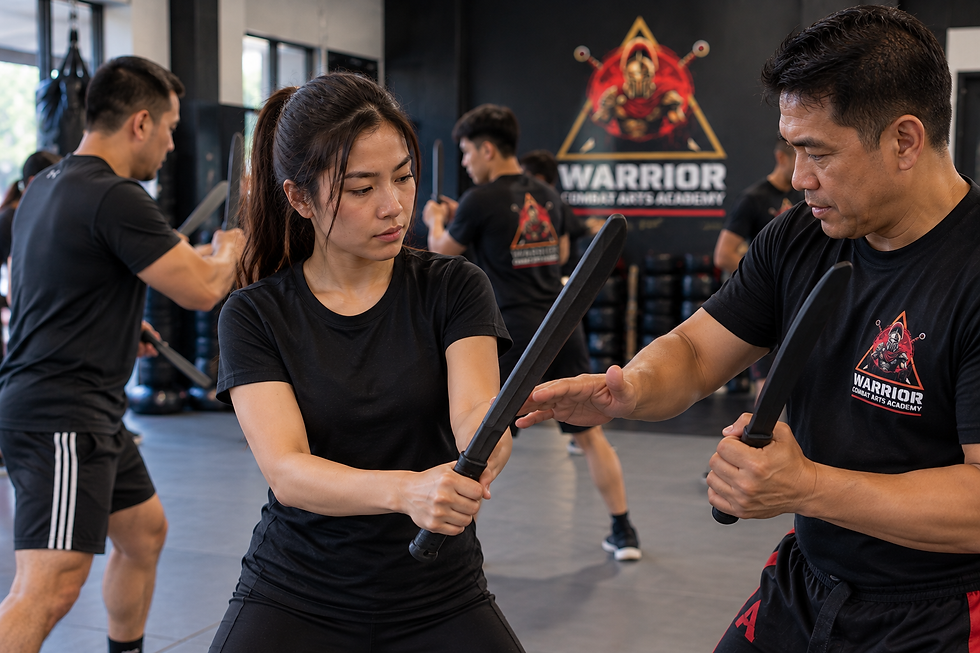
1. Weapons Change the Equation
One of the most distinctive characteristics of Filipino martial arts is that weapons aren't treated as an advanced subject reserved for students after years of empty-hand training.
Students can begin learning weapon skills very early.
Training commonly includes the single stick, double sticks, stick and dagger, knife, flexible weapons, and other tools.
Historically, the sticks used in Kali training can represent bladed weapons such as swords. They aren't merely "sticks."
The weapon teaches distance, timing, coordination, angles of attack and defensive movement.
But there is another obvious lesson:
A tool can magnify what the human body is capable of doing.
That matters enormously when size and strength are unequal.
A smaller person doesn't necessarily want to stand toe-to-toe exchanging punches with somebody twice her size.
A defensive tool changes distance.
It changes reach.
It changes leverage.
And most importantly, it can change the attacker's ability to simply overwhelm someone through physical strength.
That is the beginning of the equalizer.

2. Kali Teaches You to Recognize Everyday Tools
You probably aren't walking around carrying two rattan sticks.
And that's not the point.
Kali develops the ability to understand objects according to their function rather than their name.
An umbrella can have characteristics similar to a stick.
A flashlight can become an impact tool.
A backpack, jacket or bag can potentially create a barrier.
Other ordinary objects may help create distance or provide an opportunity to escape.
The important lesson isn't memorizing a hundred improvised weapons.
It's developing the ability to look at your surroundings and think:
What do I have available right now?
That mindset is extremely valuable in self-defense because actual emergencies rarely occur under ideal conditions.

3. Distance Can Be More Valuable Than Strength
One of the greatest advantages a smaller person can develop is an understanding of range.
If someone much stronger gets both arms around you, pins you against something, or puts you underneath his body weight, the physical problem becomes dramatically more difficult.
Kali therefore places tremendous emphasis on understanding distance.
You learn when you're outside striking range.
You learn when you're entering.
You learn how weapons change range.
And you learn how footwork can create angles rather than simply moving backward in a straight line.
The objective isn't necessarily to stand there and prove that you can defeat somebody in a fight.
For self-defense, the objective may simply be:
Create an opportunity to get away.

4. Kali Develops Coordination on Both Sides of the Body
Kali is famous for bilateral training.
Students frequently train the right and left hands independently and together through single-stick drills, double-stick patterns such as Sinawali, stick-and-dagger training and empty-hand movements.
That develops something enormously useful:
coordination under pressure.
You aren't always going to have your preferred hand available.
One hand may be carrying something.
Someone may grab an arm.
Your position may be awkward.
Kali develops the ability to adapt rather than depend upon one perfect stance or one favorite technique.
For women interested in practical self-defense, that adaptability matters.

5. Kali Doesn't Stop When the Weapon Is Gone
This is another misconception about Filipino martial arts.
Kali isn't simply stick fighting.
The system also contains sophisticated empty-hand methods.
Panantukan, sometimes called Filipino boxing, uses punches along with elbows, limb control, off-balancing and close-range striking.
Pananjakman and Sikaran incorporate kicking methods, including knees and lower-body attacks.
Dumog develops grappling, control, off-balancing and joint manipulation.
The same concepts of angles, positioning, timing and sensitivity learned through weapon training begin appearing in empty-hand combat.
That's important because real confrontations are unpredictable.
A weapon may be dropped.
Distance may suddenly collapse.
Someone may grab you.
Kali teaches the practitioner to transition rather than freeze.
6. Kali Doesn't Require You to Fight Fair
Martial arts competition requires rules.
Self-defense does not work that way.
There is no referee.
There are no weight divisions.
Nobody promises that an attacker will be your size.
And nobody guarantees that only one person will be involved.
That's why practical self-defense cannot be based entirely upon winning a fair fight.
Kali develops a different mentality:
Adapt to the problem in front of you.
Move.
Create angles.
Use leverage.
Use your environment.
Use available tools.
Create distance when possible.
And escape when the opportunity appears.
Self-defense isn't about proving who's tougher.
It's about getting home safely.
7. Weapon Training Changes the Way You See Danger
There is another benefit to Kali that has nothing to do with hitting someone.
Weapons training can dramatically change your understanding of distance, hands and intent.
When you've spent time training against sticks and training knives, you begin paying much closer attention to what someone's hands are doing.
You learn that a small change in distance can matter.
You begin understanding how quickly someone can close space.
And you learn why controlling distance and maintaining awareness may be more important than knowing fifty complicated techniques.
Good self-defense begins long before the first strike.
Whenever possible, the best confrontation is the one you recognize early enough to avoid.
8. Confidence Comes From Capability
There's an important distinction between feeling confident and actually developing capability.
Real confidence shouldn't come from someone simply telling you:
"You're strong. You've got this."
It should grow from training.
You hit pads.
You learn footwork.
You work against resistance.
You practice with partners of different sizes.
You learn weapons.
You make mistakes.
You solve problems.
And gradually something changes.
You aren't merely hoping that you could respond under pressure.
You've actually spent time developing the physical and mental tools to do it.
That's a very different kind of confidence.
The Goal Isn't to Turn Women Into Men
Women don't need to become physically identical to men in order to learn effective self-defense.
And pretending physical differences don't exist doesn't empower anyone.
A more intelligent approach is to acknowledge those differences and develop strategies that help compensate for them.
That's exactly where Kali becomes so interesting.
Reach can compensate for size.
Leverage can reduce dependence on strength.
Footwork can prevent a strength contest from happening in the first place.
Tools can magnify force.
Timing can beat speed.
Awareness can prevent an encounter altogether.
And adaptability gives you options when the original plan fails.
That is why Filipino martial arts can be such a powerful choice for women.

Kali: The Great Equalizer
No martial art can guarantee someone's safety.
No technique makes a smaller person invincible.
And responsible self-defense training should never pretend otherwise.
But good training can improve the odds.
Kali gives women something far more useful than the promise of becoming stronger than every potential attacker.
It teaches them how to avoid relying upon strength alone.
Through weapons training, empty-hand skills, footwork, leverage, awareness, coordination and adaptability, a smaller person learns ways to change the physical equation.
And when you're facing someone bigger and stronger than you, sometimes changing the equation is exactly what you need.
You don't have to be the strongest person in the room.
You need the skills to stop playing by strength alone.
Experience Kali at Warrior Combat Arts Academy
At Warrior Combat Arts Academy in Mountain View, we teach Filipino martial arts as a practical, adaptable system—not simply as stick fighting.
Students develop skills in Kali and Escrima weapons, Panantukan Filipino boxing, empty-hand defense, footwork, coordination, partner training and practical self-defense.
You don't need previous martial arts experience.
You don't need to already be athletic.
And you certainly don't need to be stronger than everyone else.
Come experience what Kali can do.
Train smart. Develop real skills. Become harder to overwhelm.
Warrior Combat Arts Academy
Mountain View, California
Jeet Kune Do • Kali/Escrima • Muay Thai • Silat • Boxing • Wing Chun


Comments