

The Filipino Martial Art That Changed Hollywood: From 300 and The Equalizer to John Wick and the U.S. Marines

How Kali and Escrima travelled from the Philippines into American military training, Hollywood action films, and the work of some of the world's most recognisable actors.
What do Denzel Washington, Keanu Reeves, Matt Damon, and the Spartan warriors of 300 have in common?
Their most memorable action scenes have connections to a martial arts tradition that originated thousands of miles from Hollywood.
Filipino martial arts.
Known as Kali, Escrima, Eskrima, and Arnis, these fighting systems have influenced American action choreography, reached U.S. military training exercises, and shaped the careers of stunt professionals responsible for some of cinema's most recognisable fights.
And behind several of those connections is one extraordinary martial arts teacher:
Guro Dan Inosanto.
His influence extends from Bruce Lee to Denzel Washington, from Hollywood stunt coordinators to the action directors who helped redefine modern cinema.
The surprising part?
Most moviegoers have no idea they're watching Filipino martial arts.

1. The Fighting Arts of the Philippines: Much More Than Stick Fighting
Filipino martial arts developed through generations of fighting traditions across the Philippine archipelago.
Different regions and lineages developed their own methods, but many systems share an emphasis on weapons, footwork, timing, distance, and adaptability.
A student might begin with a rattan stick.
But the training doesn't necessarily end there.
Depending on the system, students also study bladed weapons, empty-hand striking, kicking, joint controls, and grappling.
One distinctive feature is the relationship between weapons and empty-hand movement.
Rather than treating them as entirely separate subjects, many Filipino systems explore how related principles can apply across different situations.
This is not simply a modern interpretation.
In 2009, the Philippine government passed Republic Act No. 9850, officially declaring Arnis the country's national martial art and sport. The law recognises Kali and Eskrima among its names and explicitly includes both weapons and empty-hand techniques.
Supreme Court E-Library
That national recognition reflects the cultural importance of these arts.
Their international influence, however, tells another remarkable story.

2. Dan Inosanto: The Filipino-American Martial Artist Who Connected Two Worlds
If you want to understand how Filipino martial arts reached Hollywood, you need to understand Dan Inosanto.
A close associate and training partner of Bruce Lee, Inosanto became one of the most influential teachers of Jeet Kune Do and Filipino martial arts in the United States.
He helped introduce generations of American martial artists to fighting traditions that were unfamiliar to much of the mainstream public.
But he did something else that proved enormously important.
He taught people who went on to work in Hollywood.
His academy in Marina del Rey, California, became a training ground for martial artists, stunt performers, fight choreographers, and future action directors.
The academy's Filipino martial arts curriculum draws from numerous teachers and traditions, covering single stick, double stick, stick and dagger, Filipino boxing, kicking methods, and other areas.
This was not a school devoted to producing one particular kind of movie fight.
It was a place where people studied a broad range of martial arts—and carried that knowledge into their professional lives.
One of those people was Damon Caro.
Another was Jeff Imada.
Chad Stahelski is included on this list.
And their work would eventually reach millions of moviegoers.

3. Denzel Washington: From The Book of Eli to The Equalizer
Denzel Washington is one of the most recognisable actors in American cinema.
But many people don't know that he trained with Guro Dan Inosanto.
The Book of Eli: Training with Guro Dan
For the 2010 film The Book of Eli, Washington underwent extensive martial arts preparation with Dan Inosanto and fight choreographer Jeff Imada.
The production's own account describes months of training intended to prepare Washington for demanding fight sequences involving empty-hand combat and weapons.
Washington spoke about working with both men and expressed his respect for their martial arts expertise.
Imada designed the film's action around a traveller who had survived through years of experience. That meant the character couldn't simply look like someone performing a polished martial arts demonstration. He needed to look resourceful.
Adaptable.
Comfortable with a blade.
And capable of using his surroundings.
The filmmakers developed a fighting style that combined different martial arts and hand-to-hand combat skills, with Filipino martial arts among its important influences.
Washington's preparation was not merely a matter of learning a few impressive movements for the camera. He trained with the people who had spent their lives studying and teaching the arts.
The Equalizer: Filipino Martial Arts Return to the Screen
Now consider Washington's other major action franchise.
The Equalizer.
Robert McCall doesn't usually fight like a conventional martial arts movie hero.
He observes his surroundings.
He closes the distance.
He uses ordinary objects.
A corkscrew, a knife, or something else within reach can become part of a choreographed fight.
The connection to Filipino martial arts is not just something enthusiasts have noticed.
A promotional campaign for The Equalizer 3 explicitly described Filipino martial arts as the style used by Washington in the films. The campaign partnered with a Filipino martial arts school to introduce viewers to the discipline through a workshop.
That is a particularly revealing connection.
The people marketing the film recognised Filipino martial arts as part of the franchise's action identity.
The original Equalizer also drew on other influences. Its stunt coordinator, Keith Woulard, described creating street-oriented fighting informed by his military experience, and Washington later discussed incorporating his boxing skills into The Equalizer 2.
The larger story is that Denzel Washington's documented training with Guro Dan Inosanto connects The Book of Eli to a later action franchise in which Filipino martial arts remained part of the fighting vocabulary.
Two major Hollywood properties.
One actor.
And a martial arts tradition with roots in the Philippines.

4. The Spartans of 300 Were Fighting with Filipino Martial Arts Influences
Here is the Hollywood connection that surprises people most.
Remember the Spartans in 300?
The sweeping sword attacks.
The aggressive shield work.
The fluid transitions between weapons.
The film's spectacular fighting was choreographed by Damon Caro, a martial artist from Dan Inosanto's training lineage.
Caro was also an instructor at the Inosanto Academy. A martial arts colleague writing in 2008 recalled meeting him there and specifically identified him as the choreographer of 300's battle sequences.
Filipino martial arts publications and historical accounts identify Kali, Escrima, and Arnis as influences on the film's blade-and-shield choreography.
Why Kali for a movie about ancient Greece?
Because a filmmaker's job is not always to reconstruct a historical fighting system.
It is to create movement that communicates a story.
Filipino martial arts provide a sophisticated vocabulary for coordinating weapons, managing distance, changing angles, and integrating the weapon in each hand.
Those principles can be adapted to a sword-and-shield sequence.
In 300, the result was a highly stylised cinematic fighting system that helped give the Spartan warriors their distinctive screen presence.
The film's fighting should not be mistaken for a historically verified reconstruction of ancient Spartan combat.
But the Filipino martial arts influence behind its choreography is a remarkable example of how far these traditions have travelled.
And Caro's contribution didn't end there.
He returned as stunt coordinator and second-unit director for 300: Rise of an Empire, where he discussed adapting the fighting styles of the Spartans, Athenians, and Persians to suit the different characters and armies.
From the Inosanto Academy to the battlefields of cinematic ancient Greece.
That is quite a journey.

5. John Wick: Keanu Reeves and the Kali Connection
When audiences watch Keanu Reeves fight through the John Wick films, they see a mixture of firearms, grappling, throws, strikes, knives, and improvised weapons.
Filipino martial arts are part of that mixture.
In a 2019 interview, members of the film's stunt team explained that the knife and pencil techniques came from their Kali training.
They also identified judo and jiu-jitsu as foundational elements of Wick's fighting style.
Maxim. That matters because John Wick isn't an example of a single martial art being reproduced on screen.
It is a carefully designed combination of disciplines.
But the Filipino martial arts contribution is explicitly acknowledged by the people who created the action.
The director trained at the Inosanto Academy. He was an Inosanto instructor.
There is an even deeper connection.
Director Chad Stahelski has spoken about studying martial arts at Guro Dan Inosanto's academy in Marina del Rey, called the Inosanto Academy of Martial Arts.
He recalled encountering Filipino martial arts and other disciplines there at a time when they were far less familiar to mainstream American audiences.
Think about that.
The director who helped define the modern John Wick action style studied in the same wider martial arts environment that helped prepare Denzel Washington for The Book of Eli.
The influence isn't limited to one actor or one film.
It extends through the people designing the action.
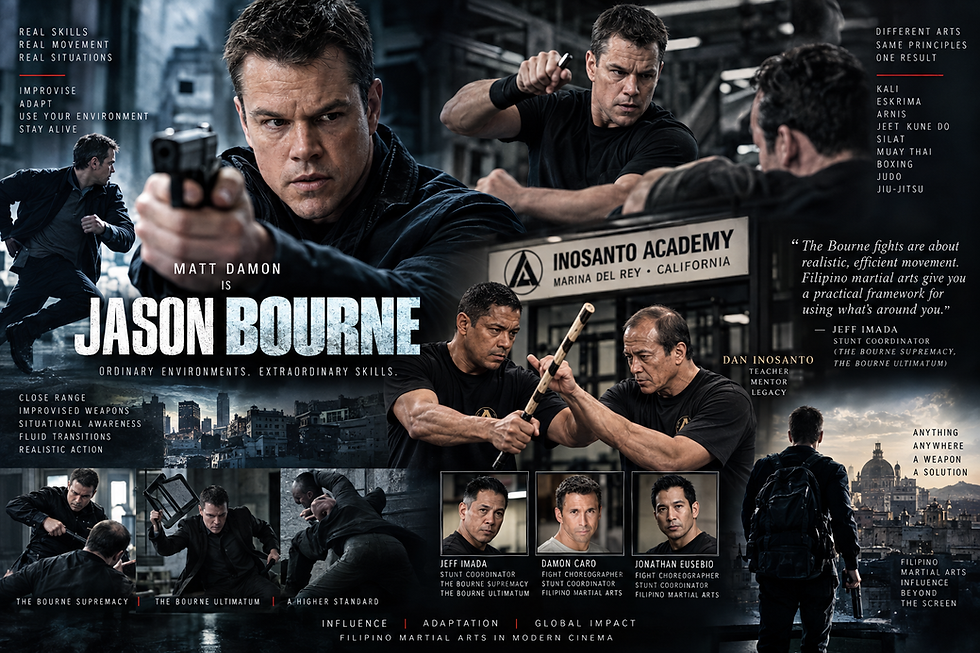
6. Matt Damon and the Bourne Films
Before John Wick became famous for improvised weapons and close-range fighting, Jason Bourne was already showing audiences a different kind of action hero.
Bourne's fights are often fast, compact, and improvised.
He uses his surroundings.
He changes distance.
And he turns ordinary objects into weapons.
Filipino martial arts are among the influences associated with the franchise's fighting style.
Jeff Imada worked on The Bourne Supremacy and The Bourne Ultimatum, while Damon Caro and Jonathan Eusebio are also identified in accounts of the films' Filipino martial arts connections.
Once again, the important connection runs through the choreographers.
The audience sees Matt Damon.
Behind the camera are martial artists bringing years of training into the construction of those sequences.
That is how Filipino martial arts can influence American popular culture without audiences ever hearing the word Kali.

7. The U.S. Marines Have Trained in Filipino Martial Arts, Too
Hollywood isn't the only American institution to recognise the value of Filipino martial arts.
The U.S. Marine Corps has documented American Marines learning Pekiti-Tirsia Kali directly from Philippine Marines during joint military exercises.
During Exercise Balikatan in 2011, U.S. Marines and their Philippine counterparts exchanged martial arts techniques.
The Americans demonstrated methods from the Marine Corps Martial Arts Program.
The Philippine Marines taught Pekiti-Tirsia Kali.
Training included stick fighting, blade-related techniques, and unarmed responses.
A U.S. Marine instructor described the Filipino methods as an additional tool Marines could add to their existing training.
This is a significant distinction.
The U.S. Marines did not abandon their existing martial arts program and replace it with Kali.
They trained with Filipino instructors and explored techniques that complemented their existing knowledge.
The exchange also illustrates the relationship between the two countries.
American and Philippine service members weren't simply watching demonstrations.
They were learning from one another.
Filipino martial arts had moved from a national fighting tradition into documented joint training with the U.S. military.
And the training included both weapons-based and empty-hand methods.

8. What About American Law Enforcement?
Filipino martial arts have also influenced specialised training within American law-enforcement and protective-service communities.
Their emphasis on distance, weapons awareness, baton-related movement, and close-range control makes them relevant to subjects encountered in professional defensive-tactics training.
The Inosanto Academy itself has published accounts discussing the relationship between martial arts instruction and law-enforcement work.
However, the influence is best understood through particular instructors, programmes, and training communities.
There is no basis for saying that every American police department or federal agency uses Kali as its official fighting system.
What is clear is that Filipino martial arts have reached beyond recreational martial arts schools into professional training environments.
That alone is a substantial cultural achievement.
9. Other Hollywood Connections You Might Recognise
The list doesn't stop with Washington, Reeves, Damon, and the Spartans.
Aaron Eckhart trained in Filipino martial arts for I, Frankenstein.
In an interview, he described spending six months studying stick fighting with Ron Balicki and Diana Lee Inosanto, including single-stick and double-stick work.
Diana Lee Inosanto is part of the same remarkable family tradition that helped bring Filipino martial arts into American popular culture.
And the broader pattern is unmistakable.
A Filipino martial arts instructor teaches a student.
That student becomes a stunt performer, choreographer, or director.
The techniques and movement principles travel onto a film set.
Millions of people watch the result.
The art reaches audiences who may never have heard its name.
10. Why Filipino Martial Arts Have Had Such an Impact
There is a reason these arts continue to attract attention from martial artists, action filmmakers, and professional training communities.
They encourage students to think about fighting as a problem of distance, timing, movement, and adaptation.
A stick is not merely a stick.
It is a training tool through which students can explore angles, coordination, and the relationship between armed and unarmed movement.
A blade changes the problem.
An empty hand changes it again.
Different situations require different responses.
That flexibility makes Filipino martial arts valuable as a subject of study.
It also gives fight choreographers a rich vocabulary for designing visually distinctive action.
Of course, real self-defence and Hollywood choreography are very different activities.
A film fight is rehearsed and designed for performance.
Practical martial arts training must account for uncertainty, resistance, and safety.
But the underlying movement principles can inform both.
11. The Same Martial Arts Tradition—Right Here in Mountain View
Now for the part that brings this story home.
You don't need to be Denzel Washington.
You don't need to work in Hollywood.
And you don't need to join the Marine Corps.
You can begin studying Filipino martial arts right here in the Bay Area.
At Warrior Combat Arts Academy in Mountain View, California, we teach Kali and Escrima as part of a progressive martial arts curriculum.
Our instruction is connected to the Inosanto tradition—the same wider martial arts lineage that has influenced major Hollywood action professionals.
Our founder and director, Adrian Tandez, teaches Jeet Kune Do and Filipino martial arts through the Inosanto lineage, alongside other complementary disciplines.
Students explore weapons training, empty-hand movement, footwork, timing, coordination, and the principles that connect these subjects.
And you don't have to be an experienced martial artist to begin.
Whether you're interested in Filipino culture, practical self-defence, martial arts education, or simply the incredible history behind your favourite action films, Kali offers something worth discovering.
From the Philippines to Hollywood. From Hollywood to Mountain View.
The next time you watch Denzel Washington in The Book of Eli or The Equalizer, Keanu Reeves in John Wick, Matt Damon as Jason Bourne, or the Spartans in 300, remember the Filipino martial arts connections behind those performances.
These films may tell very different stories.
But their action has been shaped, in different ways, by a remarkable martial arts tradition.
And that tradition is still being taught today.
Discover Kali and Escrima at Warrior
Experience Filipino martial arts at Warrior Combat Arts Academy in Mountain View, California.
Explore our martial arts programs.
Warrior Combat Arts Academy
1931 Old Middlefield Way, Unit C
Mountain View, CA 94043
Phone: 408 373 0204
Email: contact@warriorcombat.net
Website: warriorcombat.net


Comments