

Why Every Woman Should Learn Kali Escrima: The Weapons-Based Martial Art That Levels the Playing Field
- SiFu Adrian Tandez
- Jun 19, 2025
- 5 min read

In a world where personal safety is not a guarantee, women are often at a physical disadvantage in violent confrontations due to disparities in size, strength, and muscle mass compared to male aggressors. For centuries, traditional martial arts have emphasized strength, speed, and endurance—attributes that can take years to build and often still fall short when force is met with superior force.
But there is one martial art that flips this entire narrative: Kali Escrima, the weapons-based Filipino martial art that trains practitioners to be efficient, dangerous, and adaptable fighters—with or without size and strength.
The Great Equalizer: Weapons
Imagine this scenario: a woman is approached by a larger, stronger assailant in a dimly lit parking garage. Traditional self-defense methods may teach her to punch or kick her way out of the situation. But what if she's overpowered? What if her strikes are ineffective? The truth is, in real street altercations, brute strength often wins—unless you have an equalizer.
Hand-held weapons are the greatest equalizer between men and women. When wielded correctly, a blade or other edged weapon can override differences in muscle and size instantly. This is the core truth that makes Kali Escrima not only relevant—but essential—for women.

What Is Kali Escrima?
Kali, also known as Eskrima or Arnis, is a martial art that originated in the Philippines. It is known for its focus on bladed weapons, knives, swords, machetes, and improvised tools. Though it’s commonly taught today using rattan sticks for safety and training purposes, the heart and soul of Kali is—and always has been—blades.
Historically, Kali was used by Filipino warriors to defend their villages from foreign invaders, pirates, and colonizers. They trained not in sportsmanship but in efficiency and lethality, often using knives, short swords (like the bolo), and machetes, all of which were household tools turned into deadly weapons. These weapons were not only practical, they were deeply ingrained in daily life, making Kali an organic and intuitive method of combat.
Why Weapons Work for Women
Size Doesn't Matter with a Knife
In hand-to-hand combat, a 6’2” male attacker will almost always have an advantage over a 5’4” woman. But introduce a knife into the equation—especially one wielded with skill—and that advantage disappears. Kali Escrima teaches that precision, not power, wins a fight. A well-placed cut disables tendons, arteries, and ligaments. It’s not about overpowering the enemy; it’s about outsmarting and outmaneuvering them with deadly efficiency.
Speed and Angles over Force
Unlike brute-force fighting systems, Kali Escrima focuses on angles of attack, targeting vulnerable points like the throat, wrists, inner arms, and knees. It teaches you to move efficiently, flowing from one attack to the next. Women excel in this fluid style because it rewards finesse, intelligence, and anticipation—not brute strength.
Edged Weapons are Psychological Equalizers
There's a psychological edge to holding a knife or blade, even for an attacker. Many confrontations are diffused before they begin once a weapon is revealed and wielded with competence. Training in Kali Escrima arms women not just with skill, but with confidence and presence—a potent deterrent to would-be attackers.
Everyday Objects Become Weapons
A pen. A fork. A hairbrush. A key. In Kali, these are not mundane items—they are improvised weapons. Women are taught how to turn everyday tools into extensions of themselves. The training rewires how you view your environment, making you prepared for anything, anywhere.

The Blade-Centric Reality of Filipino Martial Arts
Let’s dispel a common misconception: Kali is not a stick-fighting art. While many schools begin with sticks to safely introduce concepts of range, timing, and angles, the roots of the art are embedded in blades. Filipino culture is agricultural, and the bolo, itak, and barong—all bladed tools—were as much part of daily life as they were part of warfare.
In fact, training with sticks in Kali is primarily a pedagogical tool. The stick mimics the movement of blades, but it lacks the edge. It’s a safer way to teach lethality without actually using live weapons. However, advanced practitioners, especially those training in authentic Filipino systems, transition into bladed weapons, where the real artistry and self-defense practicality emerge.
This is crucial for women: learning stick techniques alone won’t prepare you for the real-world dynamics of knife violence or self-defense. But when you train in true blade-based Kali Escrima, you learn:
How to defend against edged weapon attacks
How to use edged weapons yourself
How to apply blade-based angles and principles to improvised tools
How to create real damage with minimal effort
Street Fights Aren’t Fair—But Kali Is Prepared for That
Self-defense situations aren’t like choreographed movie scenes. They are messy, fast, and terrifying. Kali Escrima prepares women for real violence by simulating high-stress scenarios and teaching survival-based tactics.
Multiple attackers? Kali’s footwork and angle-of-attack system teaches you how to move dynamically and strike efficiently.
Takedowns and grabs? Kali integrates close-quarter blade retention and counter-grappling to ensure you’re never caught helpless.
Armed assailants? Kali’s blade-on-blade training ensures you don’t freeze or flail—you engage with purpose.
The goal isn’t to fight fair. The goal is to survive, escape, or neutralize the threat. And no martial art better prepares women for this than Kali Escrima.
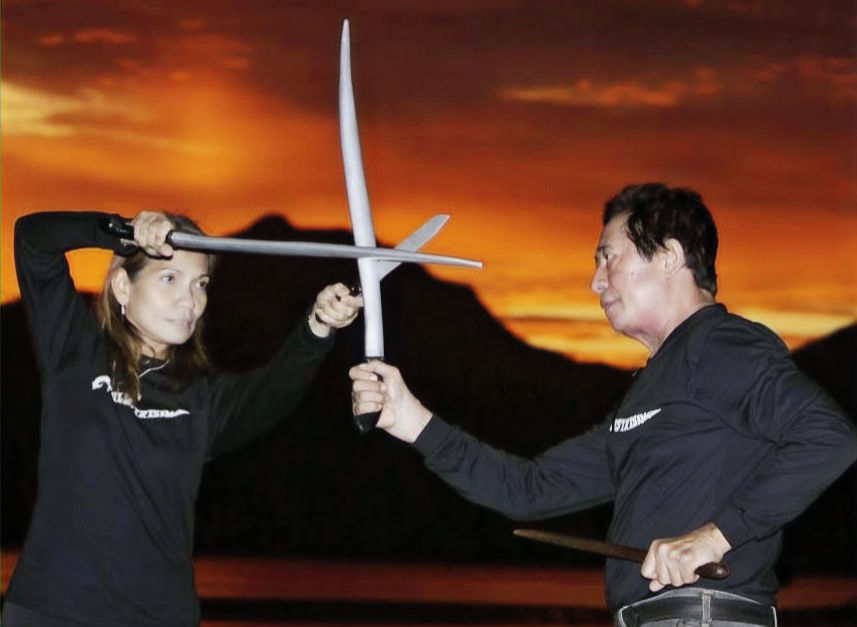
Mental and Emotional Empowerment Through Blades
Training in a weapons-based system does more than teach you how to fight. It transforms how you carry yourself. There is a profound shift that happens when a woman knows that, with just a simple tool or blade, she can defend herself against anyone. That confidence radiates in everyday life—whether walking through a parking lot at night, riding a train alone, or dealing with an aggressive stranger.
Situational awareness becomes second nature.
Fear is replaced with preparation.
Strength is redefined as control, not force.
Why Join Warrior Combat Arts Academy?
At our academy, we specialize in authentic, blade-centric Filipino Kali Escrima—not watered-down stick drills or sport-oriented versions. Our focus is on:
Realistic self-defense for modern threats
Specialized training for women, including scenario-based classes
Bladed and improvised weapon systems
Confidence building through high-stress simulation training
Whether you’ve never taken a martial arts class in your life or you’re looking to supplement your training with something more practical and effective, Kali Escrima is the system that meets you where you are and arms you with skills for life.
Women Empowering Women Through Combat Mastery
Our growing community of female practitioners are proof that the martial world is evolving. No longer do women have to rely on techniques designed for men. Kali Escrima offers a feminine-compatible, real-world-tested system that doesn’t ask you to fight like a man—it teaches you to fight smarter.
The weapons of Kali do not discriminate by gender. They don’t care about your size, your age, or your athletic ability. When placed in your hands, they are powerful tools of survival, protection, and empowerment.
Final Thoughts: Your Safety is Non-Negotiable
You don’t need to be a black belt, a bodybuilder, or a lifelong martial artist to protect yourself. You just need the right tools, the right mindset, and the right training.
Kali Escrima is not just a martial art—it’s a survival system.
And for women, it is perhaps the most important investment in self-defense and personal empowerment you can ever make.
Join us today. Train in the art that arms the mind, the body, and the spirit. Let the blade be your equalizer—and your liberation.
If you're interested in training, please contact us:
Adrian Tandez
Warrior Combat Arts Academy
Phone: 408 373 0204
Email: contact@warriorcombat.net
Web: warriorcombat.net


Comments